
Other Ways to Plan Ahead
Tools other than Advance Care Planning (ACP) to aid you in thinking about how you wish to be cared for in future.

Planning Ahead with Your Loved Ones
Apart from Advance Care Planning (ACP), there are other tools that can aid you and your loved ones in planning ahead should you lose mental capacity.
Why Do We Need to Plan Ahead?
When we are well, we take our ability to understand information, use it to make decisions, and communicate these decisions for granted. However, there may come a time when your loved ones no longer have the mental capacity make decisions for themselves. The loss of mental capacity can result from health conditions such as stroke, dementia, coma, or head trauma due to an accident. When they lack mental incapacity, they will not be able to tell you what they want or do not want.
How to Make Arrangements for Your Loved Ones?
While your loved one still has mental capacity, you can start a conversation with them to make arrangements for when they no longer have mental capacity, or when they have passed on.
 | Lasting Power of Attorney (LPA)
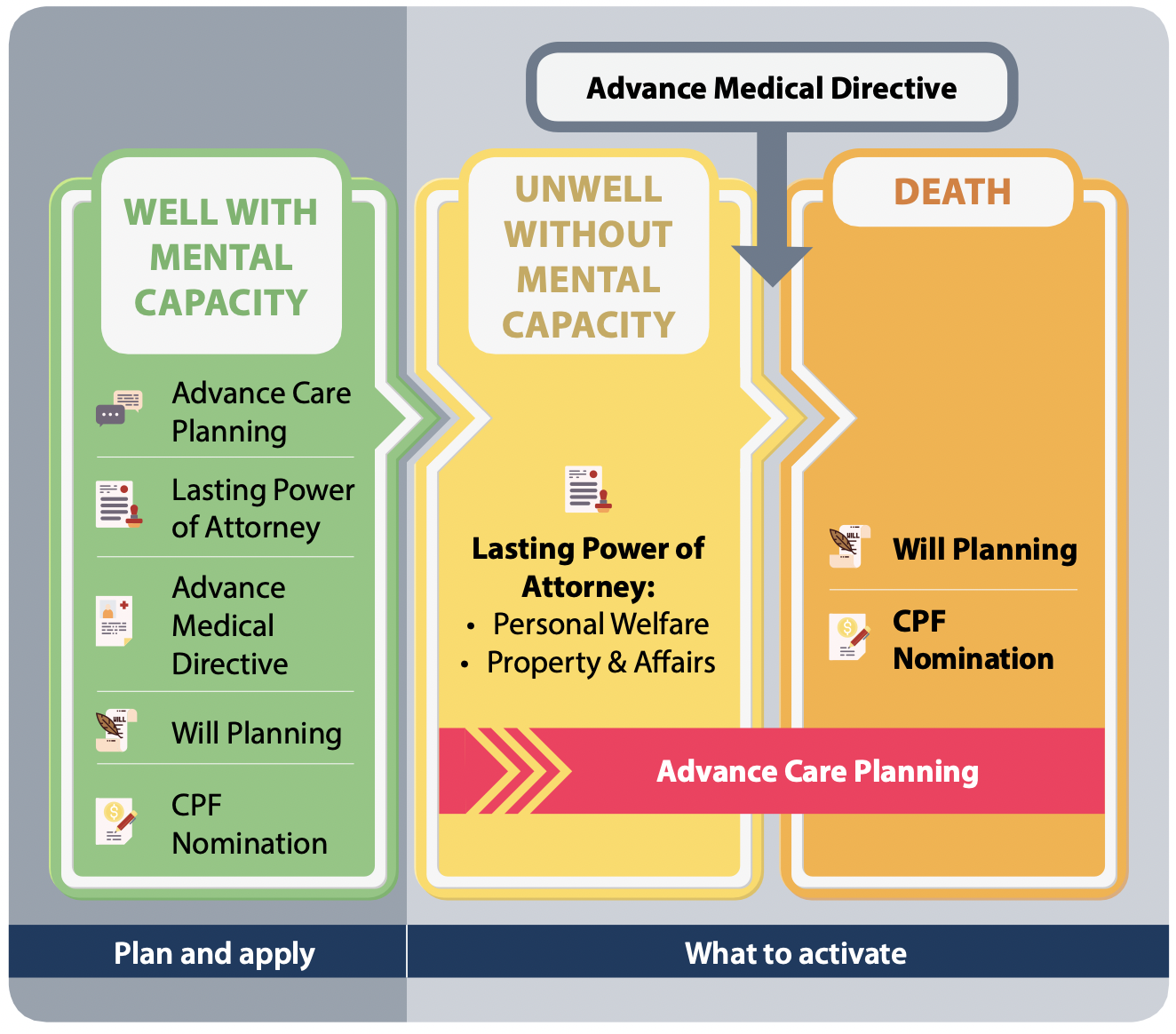
A Lasting Power of Attorney (LPA) gives you legal powers to make decisions for your loved ones when they can no longer do so. This includes decisions on their personal welfare, property, and affairs. Without an LPA, you will need a court order to administer the wishes and affairs of a loved one, which can be costly and time-consuming. Find out more information on LPA here. |
 | Advance Medical Directive (AMD)
In situations when your loved one suffers a grave illness that is incurable and likely to lead to end of life, an Advance Medical Directive (AMD) makes a legal record that your loved one would not want excessive treatment just to keep them alive.
It can help guide doctors to let your loved one pass on with dignity. Learn more about AMDs here. |
 | Will Planning
A will documents how your loved one would like to distribute their money and possessions (also called their estate) after they have passed on. Upon death, you and your family can apply to the Courts for a Grant of Probate to distribute the estate according to the will. If no will is made, the estate will be distributed according to the Intestate Succession Act or the Inheritance Certificate (for Muslims). |
 | Central Provident Fund (CPF) Nomination
Money from CPF does not form part of your loved one’s estate. This protects the fund from creditors and allows it to go directly to your loved one’s beneficiaries. CPF nomination is free of charge. Upon death, the CPF monies may be paid out via cash or cheque.
If no CPF nomination is made, you and your family may apply to the Public Trustee’s Office to distribute the CPF monies, for a fee. Find out more here. |
 | Brain Bank Singapore
The Brain Bank Singapore is a joint partnership between Lee Kong Chian School of Medicine (LKCMedicine), the National Neuroscience Institute (NNI) and the National Healthcare Group (NHG). It is set up to retrieve and store brain tissue from donors who have consented to give this gift for research after death.
Click here to read more if you or your loved ones are interested to become a donor. |
What You Should Apply and Activate at Different Stages of Your Caregiving Journey
Start Your ACP Journey
Find an ACP facilitator using the ACP Directory below.


